Azerbaijan · City Tours

5-Day Baku and Gobustan Tour with Fire Temple and Old City

5 Days Round trip from 20 km Bakı şəhərindən Easy pace

The journey

Trip highlights
  • 01 Explore the modern architectural marvel of the Heydar Aliyev Center and enjoy breathtaking views from Nagorny Park
  • 02 Discover the UNESCO-listed old town of Icheri Sheher, including the Palace of the Shirvanshahs and the Maiden's Tower
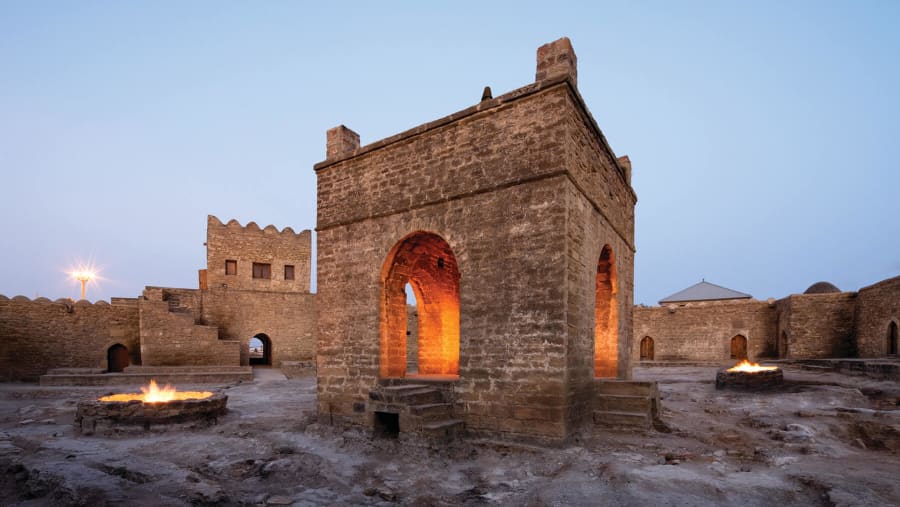
  • 03 Witness the natural fire phenomena at Ateshgah and the Burning Mountain Yanardagh
  • 04 Experience ancient rock carvings, high-tech museum exhibits, and mud volcanoes in Gobustan

Azerbaijan is a country of ancient culture and traditions, diverse nature, centuries-old history, creativity, and fantasy. It is still difficult to say whether this is Europe or Asia; perhaps only here can you enjoy a fantastic combination of Turkish, Russian, and Persian cultures. Unique Zoroastrian temples, the Caspian Sea, superb oriental cuisine, the delicate aroma of traditional tea, ancient culture, and historical monuments all await you on this journey through Baku and Gobustan.

Evening: Visit the old town of Icheri Sheher, a UNESCO World Heritage Site, and discover its many historical landmarks, including the Palace of the Shirvanshahs and the Maiden's Tower.

From the itinerary

At a glance

What this trip includes

Duration 5 Days
Tour type Shared
Activity level Easy
Accommodation Included · Premium
Transport Included
Wheelchair access No
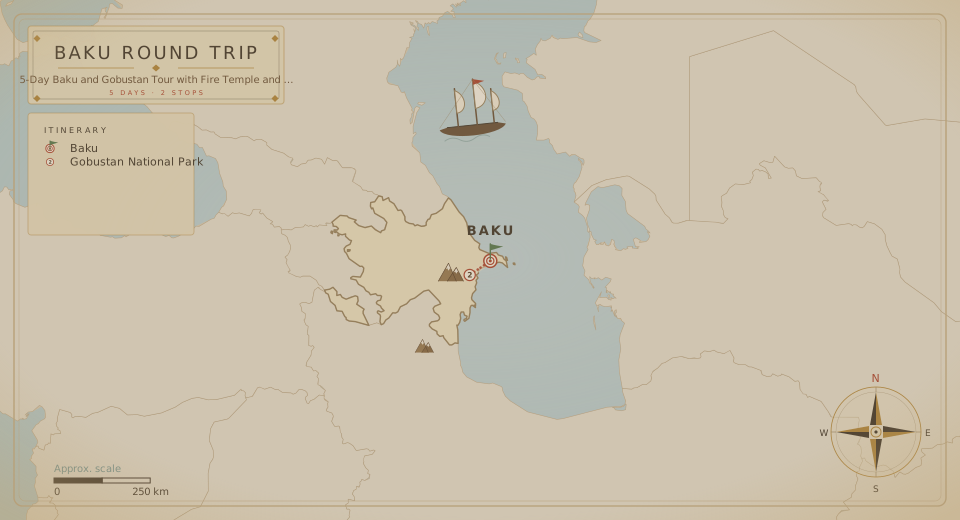
Cities Baku, Gobustan National Park
Languages Arabic, Azerbaijani, English, Russian

Day by day

The itinerary

1
Day 01

Arrival in Baku

  • Morning: Arrive at the airport and meet your guide at 10:00. Transfer to your 4-star hotel in the city.
  • Afternoon: Enjoy free time to relax and explore the local area.
  • Evening: Overnight at the hotel.
2
Day 02

Baku City Tour

  • Morning: Begin your Baku City Tour with a visit to the iconic Heydar Aliyev Center, designed by the renowned architect Zaha Hadid.
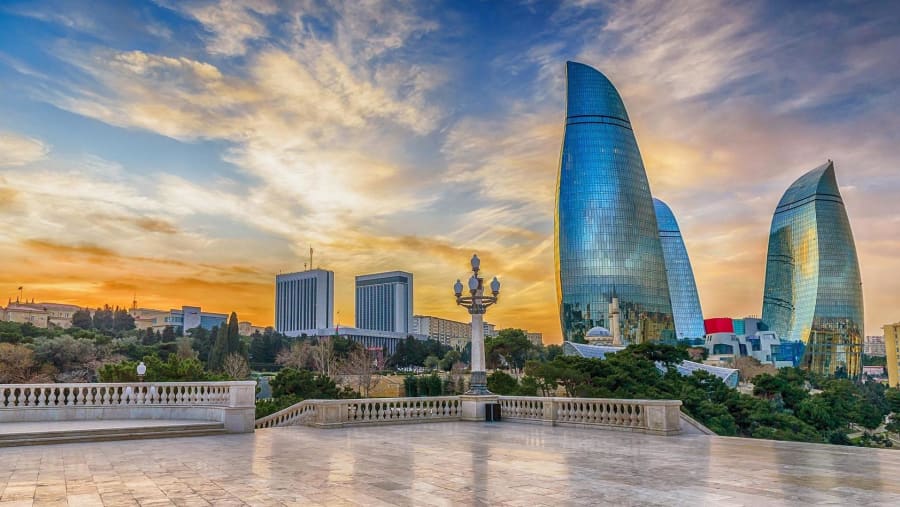
  • Midday: Proceed to Nagorny Park to enjoy panoramic views of Baku from the observation deck near the Flame Towers.
  • Afternoon: Explore the Bibi-Heybat Mosque, a significant Islamic architectural monument with a rich history.
  • Evening: Visit the old town of Icheri Sheher, a UNESCO World Heritage Site, and discover its many historical landmarks, including the Palace of the Shirvanshahs and the Maiden's Tower.
  • Night: Free time to enjoy dinner and the city nightlife. Overnight at the hotel.
3
Day 03

Ateshgah and Burning Mountain Yanardagh

  • Morning: Embark on a tour to the Temple of Eternal Fire - Ateshgyah, located in the suburb of Surakhany. Learn about its historical significance to Zoroastrians and Hindus.
  • Afternoon: Visit the Burning Mountain Yanardagh, where natural gas flames have burned for centuries, creating a captivating sight.
  • Evening: Return to Baku for free time. Overnight at the hotel.
4
Day 04

Gobustan Rock Carvings Reserve

  • Morning: Travel to the Gobustan Reserve, an open-air museum featuring ancient rock carvings and petroglyphs that offer a glimpse into the lives of early inhabitants.
  • Midday: Explore the recently built Gobustan Museum, known for its high-tech exhibits that provide context for the carvings.
  • Afternoon: Visit the nearby mud volcanoes to see these unique geological formations and experience the therapeutic mud.
  • Evening: Return to Baku and enjoy free time. Overnight at the hotel.
5
Day 05

Departure from Baku

  • Morning: Enjoy breakfast at the hotel.
  • Midday: Free time to visit the eastern market, shop for sweets, and buy souvenirs.
  • Afternoon: Transfer to the airport for your departure.
Heydar Aliyev Center, Flame Towers, Gobustan State Historical and Cultural Reserve

Where this trip takes you

Heydar Aliyev Center, Flame Towers, Gobustan State Historical and Cultural Reserve

The route

Where you'll travel

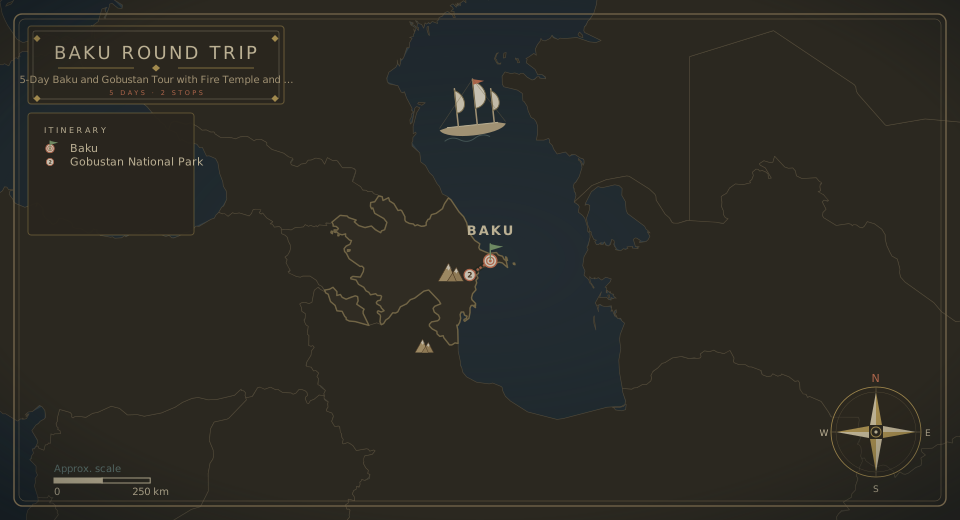
Tour route map
Round trip from 20 km Bakı şəhərindən 2 cities · 5 Days

The fine print

Trip details

What's Included

  • Accommodation in a 4-star hotel in a double room, based on breakfast
  • Transfers and transportation according to the program
  • Excursions according to the program
  • Services of an English-speaking guide
  • Entrance tickets to museums

What's Not Included

  • Lunch - from 20 USD (soft drinks included)
  • Dinner - from 25 USD (soft drinks included)
  • Supplement for single accommodation: 99 USD per tour
  • Visa cost: 40 USD (for non-CIS citizens)

What to bring

  • Good mood
  • Sunglasses
  • Money
  • Camera
  • Comfortable shoes and clothes
  • Bottle of water
  • Smile

Know before you go

  • Azerbaijan is a land of fires, and not without reason. This area has been known since ancient times for its burning hearths - ateshgahs (temples of fire) - which you can still see here with your own eyes. According to legend, Zardusht (Zoroaster) was born on this land, and the religion of fire worship, Zoroastrianism, spread here. The earliest mentions of Azerbaijan's oil wealth are also found in Persian sources. By the way, the very name "Azerbaijan" in translation from Middle Persian means "Land of Eternal Fire".
  • Visas upon arrival at international airports in Azerbaijan can be obtained only by citizens of Turkey, Israel, Qatar, Oman, Saudi Arabia, Bahrain, Kuwait, Japan, China, South Korea, Malaysia, and Singapore. For citizens of Russia and the CIS (except for Turkmenistan), a visa is not required for Azerbaijan. Citizens of other countries must obtain a visa before arrival through Azerbaijani consulates in their country or by issuing an electronic visa through our travel agency. To apply for a visa, contact our managers at least four weeks before arriving in Azerbaijan.
  • Local currency: Manat.
  • The recommended currencies for exchange are USD or EUR.
  • Where to exchange currency: Upon arrival at the airport, the guide will provide accurate information on where and how to exchange cash for local currency.
  • Availability of ATMs: Only in large cities.
  • Credit cards are accepted only in large cities.

More to know:

  • The Heydar Aliyev Center is a cultural complex with an auditorium (congress center), a museum, exhibition halls, and administrative offices.
  • The project was designed by the famous architect Zaha Hadid.
  • Baku is a city that combines modern and ancient, traditional and unusual elements.
  • The Bibi-Heybat Mosque (Azerbaijan's Bibiheybət məscidi) is located on the shore of Baku Bay.
  • The existing structure, built in the 1990s, is a reconstruction of the mosque of the same name, originally built in the 13th century by Shirvanshah Abu-l-Fath Farrukhzad and destroyed by the Bolsheviks in 1936 during the fierce struggle against religion throughout the USSR.
  • The Bibi-Heybat complex includes tombs and graves of revered people, including the grave of Ukeima Khanum, a descendant of the Prophet Muhammad. It is a spiritual center for Muslims of the East and one of the significant monuments of Islamic architecture in Azerbaijan.
  • The mosque was visited by notable figures such as Abaskuli-aga Bakikhanov, Alexander Dumas, and Khurshudbanu Natavan.
  • The local population in the past called it "the mosque of Fatima".
  • Alexander Dumas described the mosque after visiting it in the 1840s.
  • At the end of the modern Baku tour, we visit the world's first oil well drilled in the Bibi-Heybat oil-bearing region.
  • Icheri Sheher is called a fortress because of its well-preserved fortress wall.
  • People lived in the territory of Icheri Sheher during the Bronze Age, and by the 8th-11th centuries it was completely populated.
  • Behind the walls, there are many unique monuments: the palace complex of the Shirvanshahs with a burial vault, a sofa, and a mosque; "Gyz Galasy" ("The Maiden's Tower"); mosques and minarets; and the remains of caravanserais and baths.
  • The buildings of the old fortress have a special character. Due to the lack of space, they were erected wall to wall from ancient times.
  • There are no gardens, and the yards are extremely small, separated by narrow streets, lanes, and dead ends.
  • When the Shirvanshahs moved their capital from Shemakha to Baku in the 15th century, major construction began in Icheri Sheher.
  • During this period, the pearl of the fortress, the Palace of the Shirvanshahs, was built.
  • It should be noted that from the 17th to the 19th centuries, Baku did not extend beyond the boundaries of Icheri Sheher. The palaces of the rulers and residential quarters were located here.
  • From 1747 to 1806, Icheri Sheher was the capital of the Baku Khanate.
  • Only after the beginning of the oil boom did the city begin to expand beyond the boundaries of Icheri Sheher.
  • The fortress wall itself is of interest. Once Baku had two walls separated by moats, but in the early 19th century the city grew so quickly that it became necessary to demolish the outer wall.
  • The inner wall remains, featuring 25 towers and 5 gates.
  • In the 1930s, the fortress had more than 900 buildings, but by the early 21st century only half remained.
  • The Temple of Eternal Fire - Ateshgyah - is an authentic Azerbaijani exotic and is well known practically all over the world. It is located 30 km from the center of Baku in the suburb of Surakhany. This territory is known for the unique natural phenomenon of burning natural gas outlets, where underground gas reaching the surface comes into contact with oxygen and ignites.
  • The temple in its present form was constructed in the 17th-18th centuries by the Baku-based Hindu community related to Sikhs. However, the history of the temple is even longer. From ancient times, this was a holy place of Zoroastrians - fire worshippers - who attributed mystical significance to the inextinguishable fire and came here to worship the relic.
  • After the introduction of Islam, the Zoroastrian temple was destroyed. Many Zoroastrians left for India and continued their worship there. In the 15th-17th centuries, Hindu fire worshippers who came to Absheron with trading caravans began making pilgrimages to Surakhany, and Indian merchants started the restoration of the temple.
  • The earliest part of the temple is dated to 1713. The latest part - the central temple altar - was built with the support of merchant Kanchangar in 1810.
  • During the 18th century, chapels, cells, and a caravanserai were added to the central part of the temple. You can find carved inscriptions in Indian lettering there.
  • In the early 19th century, the temple acquired its present-day appearance. Ateshgah is a pentagonal structure with a castellation and entrance portal. In the center of the yard, the altar-sanctuary is executed as a stone pavilion, and in the center of the altar is a well from which "eternally" burning gas once emerged.
  • One of the most famous and popular tourist places of the "eternal flame" in Azerbaijan is Yanar Dag. It is more of a hill than a mountain, with natural gas burning on its slope since ancient times. Meter-long tongues of fire lick the stratified earth across an area approximately 10 m wide, searing those who approach too closely. People sit on the benches to watch the blazing hill in the evening, when the sight is most impressive.
  • Yanar Dag is located 25 km north of Baku, in Mehemmedi village. Buses run there from the city, so it can be reached relatively cheaply and easily. Since 2007, Yanar Dag has been a state-protected conservation area.
  • The Gobustan reserve is 60 km from Baku, between the slope of the Great Caucasus Ridge and the Caspian Sea.
  • Gobustan is an open-air reserve reflecting the life and everyday world of primitive people from the Mesolithic period until the Middle Ages.
  • Ancient rock carvings, pictograms, and petroglyphs occupy a special place here. These ancient monuments of art reflect the worldview, economy, customs, and traditions of ancient Azerbaijanis.
  • Male and female images characterize Gobustan. The drawings depict men in hunting scenes with bows and arrows. They are tall, with slender, belted bodies.
  • In the reserve, you can also see animals that lived here during the last 10,000 years - gazelles, wild goats, deer, wild pigs, horses, lions, and more.
  • There are also images of birds, fish, snakes, lizards, and various insects on the rocks.
  • Ancient rock carvings on various topics abound in compositional scenes reflecting the diversity of human activity. These include the Azerbaijani dance of Yally, collective labour, hunting with various weapons, swimming on a Tigris-type boat, reaping animals, and predators attacking herbivores.
  • Perhaps Yally was performed to the sound produced by the oldest musical instrument, "Gavaldash," a stone with a deep resonating sound.
  • Before the Gobustan tour, we visit the museum of the same name, which was recently built and is distinguished by its high technological level.

Logistics

Meeting & route

Meeting point
Baku, Azerbaijan
Tour start
20 km Bakı şəhərindən, Şimal, Азербайджан
Tour ends at the same location as the start point.
End of the journey

Your 5 days finish where they began, in 20 km Bakı şəhərindən.

Watch the tourHQ film Watch the film

Create your own adventure

Can't find the perfect tour? Tailor your dream trip.

  • Tell us your destination, dates and group size.
  • Our travel experts and local guides design a tailored itinerary, just for you.
  • Enjoy your trip with peace of mind, knowing everything is taken care of.
Plan my holiday

Say goodbye to travel stress.

Starting from

USD 480 /person
Book This Tour

When

Travellers

Total